
Two recurring questions in freight coordination are why shipment updates take time and why the final transport charge can differ from an initial quote. The way a shipment is arranged affects how information, costs and decisions move between the parties involved.
Freight can be coordinated directly with a forwarder appointed by the buyer, or through a supplier that agrees to arrange transport. Both options can be practical. Their suitability depends on the service scope, communication process, cost basis and the level of coordination each party is prepared to undertake.

Direct coordination with a capable existing forwarder can shorten the path for logistics questions. Supplier-coordinated transport can reduce the buyer’s day-to-day involvement, provided both parties agree the tasks, update process, pricing basis and approval limits.
1. Comparing direct and supplier-coordinated transport
There is no single best arrangement for every product, route or shipment. A suitable forwarder needs to understand the route, accept the actual goods and provide the services the shipment requires. A familiar contact is useful only when the provider can handle this particular order.
| Decision factor | Buyer-appointed forwarder | Supplier-coordinated transport |
|---|---|---|
| Direct logistics updates | The buyer can contact the chosen forwarder directly. | Updates may pass through the supplier unless direct contact is arranged. |
| Less day-to-day involvement | The buyer normally manages the logistics relationship. | The supplier can coordinate agreed tasks on the buyer’s behalf. |
| Several suppliers | A forwarder may offer consolidation across multiple orders. | Consolidation may be possible, but needs to be included in the arrangement. |
| Destination clearance and delivery | The buyer can choose a provider with suitable destination partners. | The buyer should confirm the destination contact and exactly what is included. |
| Comparing costs | The buyer can ask the forwarder to explain the quote directly. | The buyer should ask how freight, coordination fees and any allowance are presented. |
Neither option guarantees a cheaper shipment, a faster response or a successful clearance. Compare providers using the same destination, cargo details and delivery scope.
2. When direct coordination with a forwarder may be more convenient
An established importer often has a forwarder that already knows its consignee details, receiving warehouse and preferred delivery procedures. Reusing that relationship can reduce repeated explanations and give the buyer a familiar contact when a shipment needs attention.
It can also make decisions easier. The buyer can discuss a route change, request a breakdown of charges, ask about consolidation or speak with the destination team directly. The supplier still coordinates the agreed origin handover and provides the relevant cargo information.
Before appointing a provider, check that it can arrange collection at the agreed origin location and support the required destination services. A local office or familiar name alone does not confirm that the full route is covered.
3. An extra communication layer can lengthen the update cycle
Suppose a buyer notices that tracking has stopped updating and asks the supplier what happened. The supplier contacts the forwarder. The forwarder may then need an answer from the carrier, warehouse or destination agent. Once an answer arrives, it goes back to the supplier and then to the buyer.
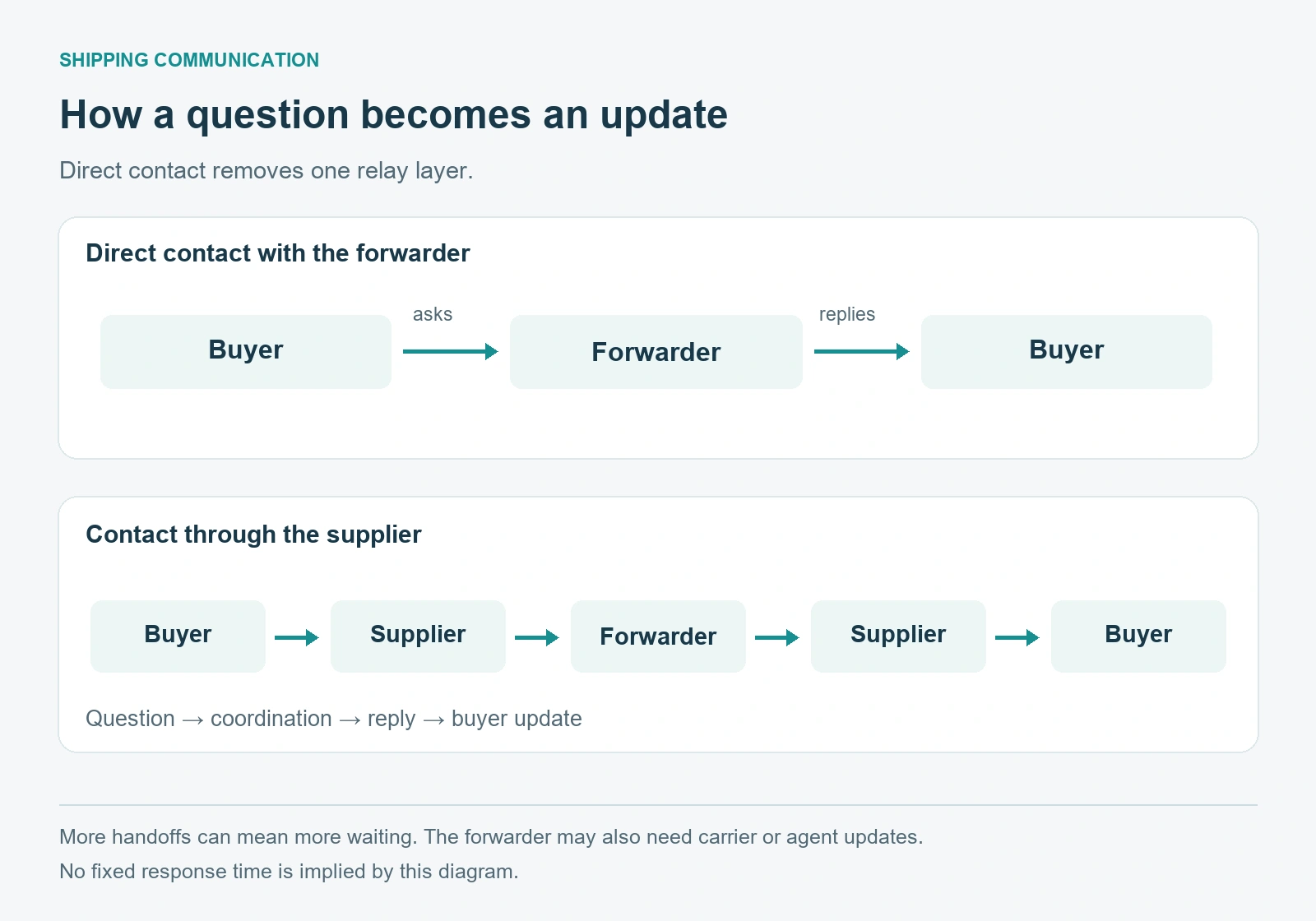
This does not necessarily mean that the supplier is ignoring the buyer or that the forwarder is providing poor service. It means that the update has to pass through more people. Different working hours, missing information and repeated clarification can all extend the cycle.
Direct contact removes one relay step. It does not make information available before the carrier has it, and a buyer-appointed forwarder may still depend on other parties. The benefit is a shorter path for questions, clarification and escalation.
The supplier can handle booking and origin coordination while the buyer is included in a shared email thread or introduced to the forwarder’s shipment contact. Agree who makes decisions and who responds to urgent issues so that shared contact does not create conflicting instructions.
4. How initial quotes differ from final freight charges
A first quotation may be based on estimated carton dimensions, expected gross weight, a planned cargo-ready date and a proposed route. It is a price for those assumptions, usually subject to the provider’s stated validity period and terms.
The freight forwarder or carrier may weigh and measure the fully packed cargo when it receives it, and may also audit the shipment later. This is different from waiting until the final buyer receives the goods. Pallets, protective packing, straps and a carton that bulges slightly can change the measurements used for billing.
For many express and air services, the provider compares actual gross weight with dimensional or volumetric weight. The chargeable weight generally follows the larger figure under the applicable service rules. Sea, road and consolidated freight can use different pricing bases, minimum charges and surcharges.
A common express calculation is:
The divisor, dimension rounding, weight increments and treatment of multiple packages must be confirmed for the quoted service. For example, DHL’s published express guidance explains a divisor of 5,000. That is an example of a service rule, not a universal formula for all freight.
5. A two-centimetre change can affect the billing step
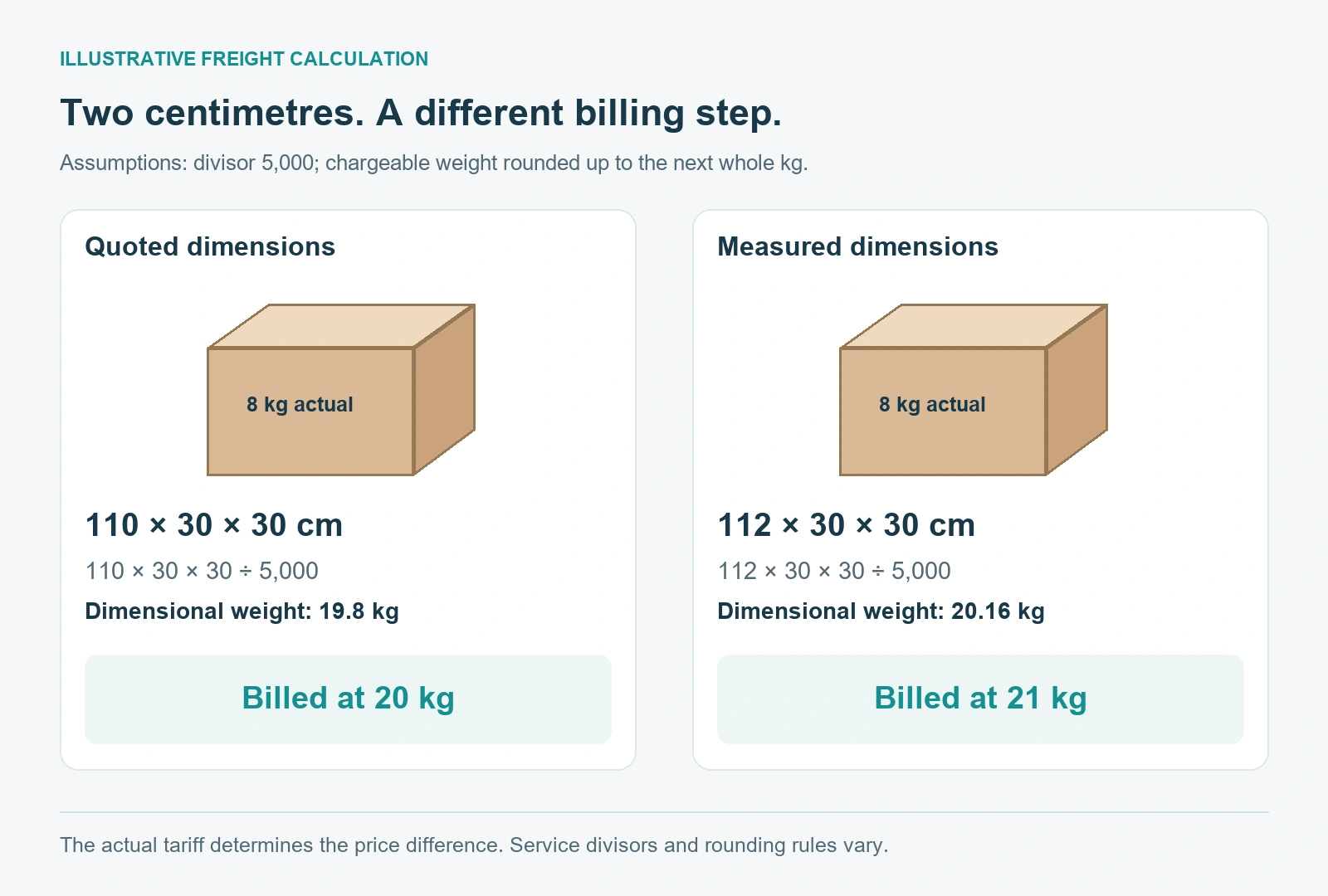
Consider one packed carton with an actual gross weight of 8 kg. For this illustration only, assume the service uses a divisor of 5,000 and rounds the chargeable weight up to the next whole kilogram.
| Calculation | Quoted dimensions | Measured dimensions |
|---|---|---|
| Packed carton | 110 × 30 × 30 cm | 112 × 30 × 30 cm |
| Actual gross weight | 8 kg | 8 kg |
| Dimensional weight | 110 × 30 × 30 ÷ 5,000 = 19.8 kg | 112 × 30 × 30 ÷ 5,000 = 20.16 kg |
| After the assumed rounding | 20 kg | 21 kg |
In this example, the carton has not become heavier. It occupies slightly more space, and the assumed pricing rule moves it into another chargeable-weight increment. The actual price difference depends on the tariff; it cannot be inferred as a fixed percentage from the weight change alone.
Other services may round in half-kilogram increments, use different divisors or apply size-related surcharges. UPS’s measurement guidance also illustrates why dimensions and rounding rules matter. If a measured figure seems wrong, ask for the recorded dimensions, weight and basis of calculation before accepting an adjustment.
6. Why a supplier’s estimate may be higher than an initial forwarder quote
When a buyer asks a supplier to coordinate transport, the amount presented by the supplier may be higher than a forwarder’s initial indicative quote. Several explanations are possible:
- A measurement allowance. The supplier may allow for a larger final chargeable weight after the cargo is packed and measured.
- A different service scope. One amount may include pickup, handling, documentation or delivery that the other does not.
- Coordination charges. The arrangement may include a disclosed service fee or margin for managing booking and shipment follow-up.
- Timing or rate assumptions. The estimates may use different booking dates, quote-validity periods, currencies or applicable charges.
These are possibilities, not evidence that every supplier quote contains a buffer or that every difference is justified. A forwarder’s first quote can also change after measurement or booking. The buyer should ask for an explanation of what the supplier’s amount covers.
Is it a fixed price for an agreed scope, an estimate subject to adjustment, or actual freight cost plus a stated coordination fee? If there is an allowance, ask whether unused amounts are reconciled or retained under the agreed price. Confirm which changes require the buyer’s approval.
7. Supplier coordination involves more than asking for a freight price
A supplier that agrees to coordinate shipping may need to collect packing information, compare routes, confirm cargo acceptance, align the booking with production readiness, prepare documents, arrange pickup and handle questions about the handover.
After dispatch, the work can include chasing status updates, clarifying measurement differences, forwarding document requests, checking destination charges and helping connect the buyer with the right party when there is a delay or a claim.
Which tasks the supplier actually performs should be agreed in advance. A supplier is not automatically the carrier, customs broker, importer of record or insurer. Coordination does not, by itself, transfer those parties’ obligations or guarantee an outcome.
8. Agreeing a supplier-coordinated shipping arrangement
Supplier-coordinated transport can be a reasonable choice for a buyer who does not want to manage a separate logistics relationship. It works best when the buyer understands the possible communication delay, agrees how freight adjustments will be handled and gives the supplier the information needed to coordinate the shipment.
A written request can clarify the scope. For example:
“Please help select a suitable freight forwarder and coordinate this shipment. I prefer you to be my main contact for transport arrangements.
Please confirm the route, delivery scope, quote validity, expected transit time and any coordination fee. I understand that a provisional freight estimate may change after the packed cargo is measured and that updates may take longer when they pass through several parties.
Before booking, please explain how the final freight amount will be settled. Please seek my approval for costs above the agreed budget or tolerance and for changes to the agreed service. Let us also confirm the tracking contact, update schedule and process for urgent issues.”
Accepting the possibility of an adjustment is not the same as authorizing unlimited extra charges. A clear approval limit protects the buyer and gives the supplier a practical basis for proceeding.
9. Details to confirm before booking
- The goods and packing: product description, carton or pallet count, final external dimensions, gross weight and any special handling requirements. Declare any batteries or other restricted characteristics accurately.
- The route and delivery point: transport mode, origin handover location, destination and whether the quote ends at a port, airport, warehouse or final address.
- The complete charges: freight, origin services, destination services, brokerage, taxes and duties where applicable, insurance and possible additional fees.
- The price basis: divisor or volume basis, rounding, minimum charges, size thresholds, quote validity and how final measurement differences are reconciled.
- The communication plan: the main contact, tracking reference, update frequency and escalation contact for urgent issues.
- The written responsibilities: the agreed trade term and named place, customs responsibilities, insurance and the procedure for loss, damage or delay.
Choosing who finds the forwarder does not automatically choose the trade term. For example, buyer-appointed transport can be compatible with FCA under Incoterms® 2020; it does not automatically mean EXW. The ICC Academy’s FCA and EXW explanation describes why the named delivery place and allocation of obligations matter.
10. Choosing an arrangement that fits the shipment
A capable existing forwarder can be a practical choice when direct logistics communication and an established destination relationship are priorities. Supplier-coordinated transport can suit an arrangement where fewer day-to-day contacts are preferred. In either case, the scope, pricing basis and update process should be agreed before booking.
A clear arrangement identifies the main contact, the services included, the basis for final freight charges and the point at which additional approval is needed. These details allow the parties to compare options on the same basis and coordinate the shipment with fewer misunderstandings.
This guide describes common coordination choices. Carrier rules vary by service, route and account. The confirmed quotation, booking terms and sales agreement govern the actual shipment.

 info@drpenfactory.com