
Why Your Microneedling Pen OEM Supplier’s Quality System Matters More Than Price
In the fast-growing world of beauty devices, microneedling pens are having a moment. They promise professional-looking results at home and consumers love the convenience. If you are a brand owner, this feels like a great opportunity.
But many new brands make a dangerous mistake. They choose an OEM supplier based mainly on price. If you think, “As long as it looks similar and works more or less the same, I will take the cheapest option,” you may be putting your entire brand at risk.
Here is the truth for a microneedling pen: your OEM supplier’s quality system is far more important than their price. Why? Because this is an invasive device. It breaks the skin. In some cases, it can even reach the superficial blood vessels. A quality failure does not just mean a returned product — it means infections, scarring and permanent skin damage. And your brand will be held responsible.
What Low Cost Really Hides
How do low-cost suppliers keep their prices down? They cut corners in ways you cannot see right away.
- Needles: They may use non-medical grade stainless steel. They often skip expensive electropolishing and passivation. Under a microscope, those cheap needles have burrs. When they go into the skin, they tear rather than puncture cleanly. The result? Granulomas, repeated irritation and allergies.
- Drive train: Some use basic plastic gears instead of high-wear POM or metal. After a few thousand cycles, those gears wear out. The needle stroke becomes unstable, or the motor may suddenly speed up or stop. This can cause skin tearing.
- Electronics: They leave out waterproof coatings and overcurrent protection. Disinfectant seeps inside. The device shorts, or the battery overheats. Both are burn hazards.
- Quality system: They do not have ISO 13485. They keep no batch records. There is no incoming inspection. Every batch is a gamble. And when something goes wrong, you cannot trace the problem.
All these shortcuts might save you a couple of dollars per unit. But they put your brand at risk of a recall that could cost hundreds of thousands — or even millions. And in the end, your reputation pays the price.
A Real Quality System Is Your Only Protection
To sell a microneedling pen in mainstream markets — the US, Europe, China, Japan — regulators treat it as a medical device. That means your OEM supplier must meet strict requirements.
They need ISO 13485, the international standard for medical device quality management. It covers everything from design and development to production and delivery, with risk management built into every step.
They need traceable batch records. Every batch of materials, every production parameter, every test result must be recorded. If a customer reports a problem, you can find exactly which batch is affected and act fast.
They need complete testing capabilities. This includes microscopic inspection of needle tips, biocompatibility reports (ISO 10993), electrical safety (IEC 60601) and electromagnetic compatibility.
They need strict change control. Any change in material or process must be validated and communicated to you. No silent substitutions.
Without these things, you cannot get FDA 510(k) clearance in the US, MDR certification in Europe, or NMPA registration in China. No registration means no legal sales in major markets. You will be stuck in low-price channels, competing on cost alone and you will never build a real brand.
What a High-Quality OEM Partner Looks Like
Take Byall, a company with years of experience in precision beauty devices. For them, quality is not a slogan — it is built into every engineering choice.
- Motor and transmission: Byall uses long-life brushless motors, metal eccentric wheels and self-lubricating POM linkages. Even after hundreds of thousands of cycles, the stroke stays accurate within ±0.05mm. That means a stable, smooth experience for the end user.
- Needle and tip: Their disposable needle tips are made from medical-grade 316L stainless steel. Each needle is electropolished to a mirror finish. They pass the full ISO 10993 biocompatibility suite. Every batch is tested for penetration force and inspected under a microscope before shipping.
- Safety and control: Byall builds Hall sensors into the pen to monitor needle position in real time. If the stroke goes beyond the safe limit, the system cuts power immediately. The circuit board has a Parylene coating, so it survives regular disinfection. The whole unit meets IPX4 water resistance.
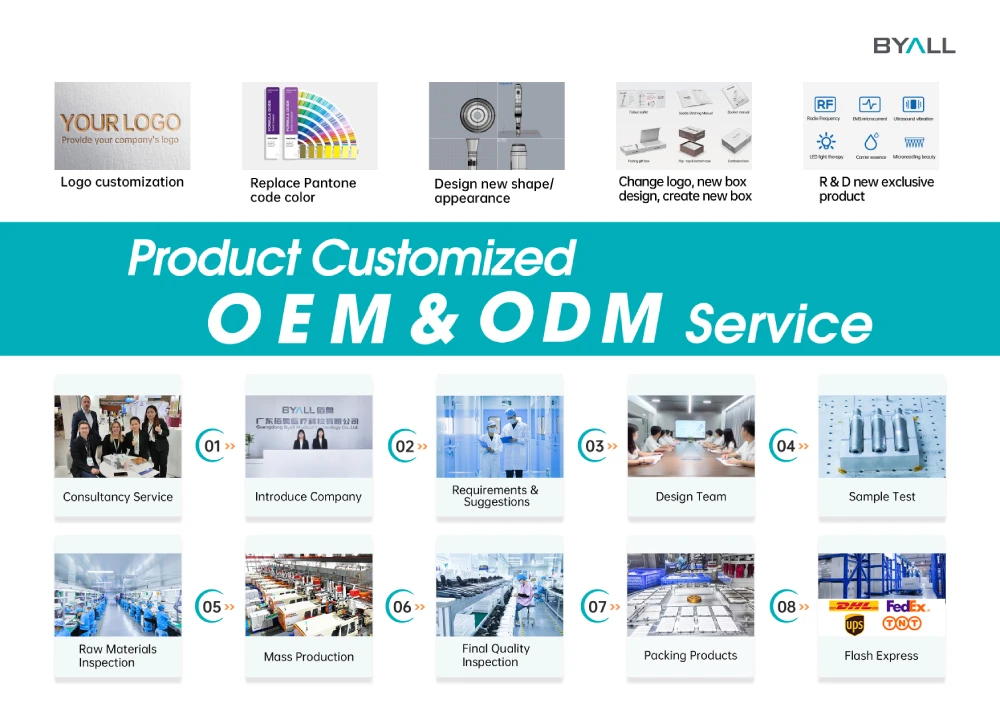
- Regulatory support: Byall holds a valid ISO 13485 certificate. They can provide a complete design history file and technical documentation. This allows you, the brand owner, to register the device as a medical device in multiple markets around the world.
When you work with Byall, you are not just buying parts. You are buying a proven risk management system, a complete regulatory file and a partner who puts user safety ahead of short-term profit.
Final Thoughts
If you are building a brand around a microneedling pen, remember this: choosing the cheapest OEM supplier is like gambling with your reputation. Choosing a supplier with a real quality system is an investment in your brand’s future.
Consumers are becoming more informed every day. Regulators are tightening their requirements. Quality is no longer just a cost — it is your competitive advantage.
Do not wait until a customer posts photos of an infection or a scar. Do not let a few dollars per unit decide the fate of your brand. Choose an OEM partner like Byall, one that respects quality and takes safety seriously. That is how you build a brand that lasts.
 info@drpenfactory.com