
How a Micro-Needling Pen Achieves Mechanical Stability and Structural Consistency
A micro-needling pen’s ability to deliver both precision and stability comes down to a set of carefully integrated design features. To make this clearer, we can break it down into three core areas.
1. Precision: Ensuring Structural Consistency
This is about making sure every puncture is the same—same depth, same angle, same force. Inconsistencies here are what cause discomfort or patchy results.
- Precision Motor and Constant Force Control
At the heart of the device is a high-speed linear motor. It drives the needles in a rapid vertical motion using precisely controlled electronic signals. What makes it truly effective is its ability to monitor changes in skin resistance in real time and adjust its power output on the fly. This is why you get a uniform penetration depth even when moving between areas of different thickness, like the forehead and the delicate skin under the eyes. - Mechanical Limit and Depth Gauge
This is the most straightforward physical safeguard. A dial or a latch mechanism on the top of the pen lets you precisely set how far the needle tip is exposed, usually in 0.25 mm steps. Once that depth is set, the mechanical structure physically limits the needle’s maximum stroke. This eliminates any risk of the needle going too deep due to a motor malfunction. - High-Precision Molding and Assembly
The detachable needle cartridge is the deciding factor for consistency. It contains dozens of micro-needles, and their tips must be perfectly aligned on the same plane. This is achieved through MEMS (Micro-Electro-Mechanical Systems) or high-precision injection molding. The entire array is formed from a combination of professional-grade materials and then sorted by automated equipment under a microscope. This guarantees an exceptionally high degree of consistency in both dimensions and tip geometry for every single needle.
2. Stability: Ensuring Mechanical Robustness
This refers to the needle’s ability to resist breaking or bending during high-speed insertion and retraction, while still transferring energy effectively.
- High-Strength Needle Material
Most home-use pens use stainless steel, which offers a good balance of strength, flexibility, and cost. More advanced, professional-grade pens might use single-crystal silicon, which has an exceptionally sharp edge but is more brittle, or a titanium alloy, which is lightweight, extremely strong, and has excellent biocompatibility. The choice of material is the foundation for preventing the needles from bending or snapping. - Optimized Structural Mechanics Design
The needle length is typically kept within a 0 mm to 1 mm range. This is a deliberate choice to avoid structural instability that comes with a high length-to-diameter ratio. The tip geometry is also carefully designed to concentrate the insertion stress right at the point. This focuses the force and prevents the needle shaft from bending under excessive axial pressure. - Dynamic Vibration and Guidance Mechanism
The motor isn’t simply pressing the needles in with brute force. It uses a high-frequency, micro-amplitude vibration. This approach significantly reduces the puncture force required and, as a result, the stress on the needle body. At the same time, an internal precision guide rail keeps the needle movement absolutely perpendicular. This eliminates oblique shear forces, which are the most common reason for a needle to bend or break.
3. Sustained Stability: System-Level Integration
For the first two points to hold up over the device’s entire lifespan, the overall design has to support them.
- Damping and Shock Absorption
Inside the pen’s body, there are damping mechanisms that absorb the motor’s vibrations. This makes the device more stable to hold and protects the of its internal connections. - Anti-Contamination Barrier and Byall’s Innovation
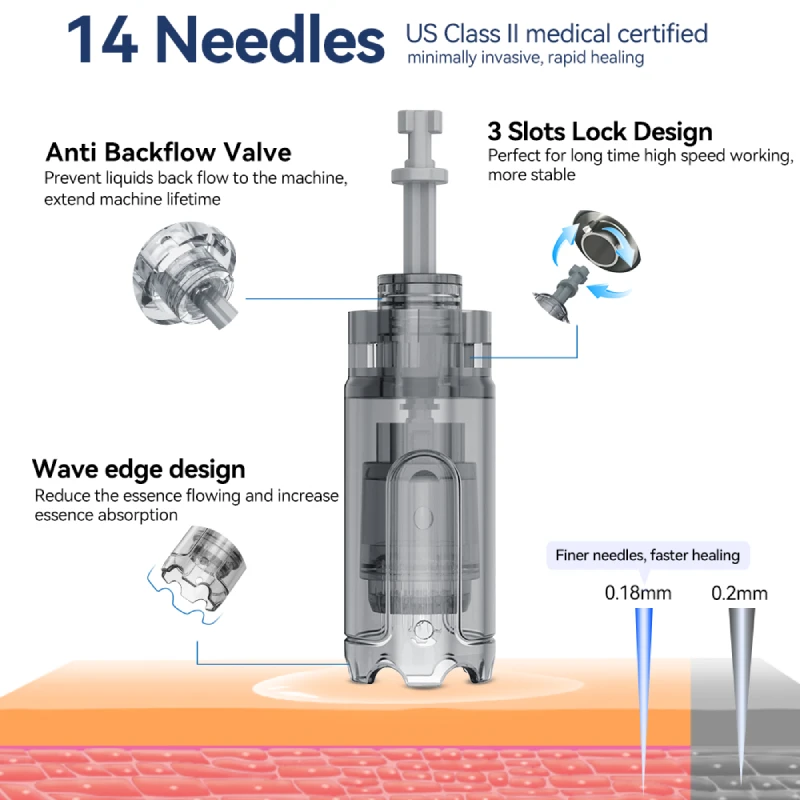
One easily overlooked design feature is its sealing. A well-designed seal does two things: first, it stops serums or blood from flowing back into the machine and corroding the precision components; second, it provides a flexible support point for the rapidly vibrating needle cartridge, which is a structural stability measure in itself. A great example of this thinking is Byall’s proprietary anti-backflow needle design. It is specifically engineered to prevent serums and blood from being drawn back into the device, eliminating any risk of cross-contamination and keeping the user safe. This needle design has now been adopted by several mainstream brands and is highly rated by consumers.
 info@drpenfactory.com